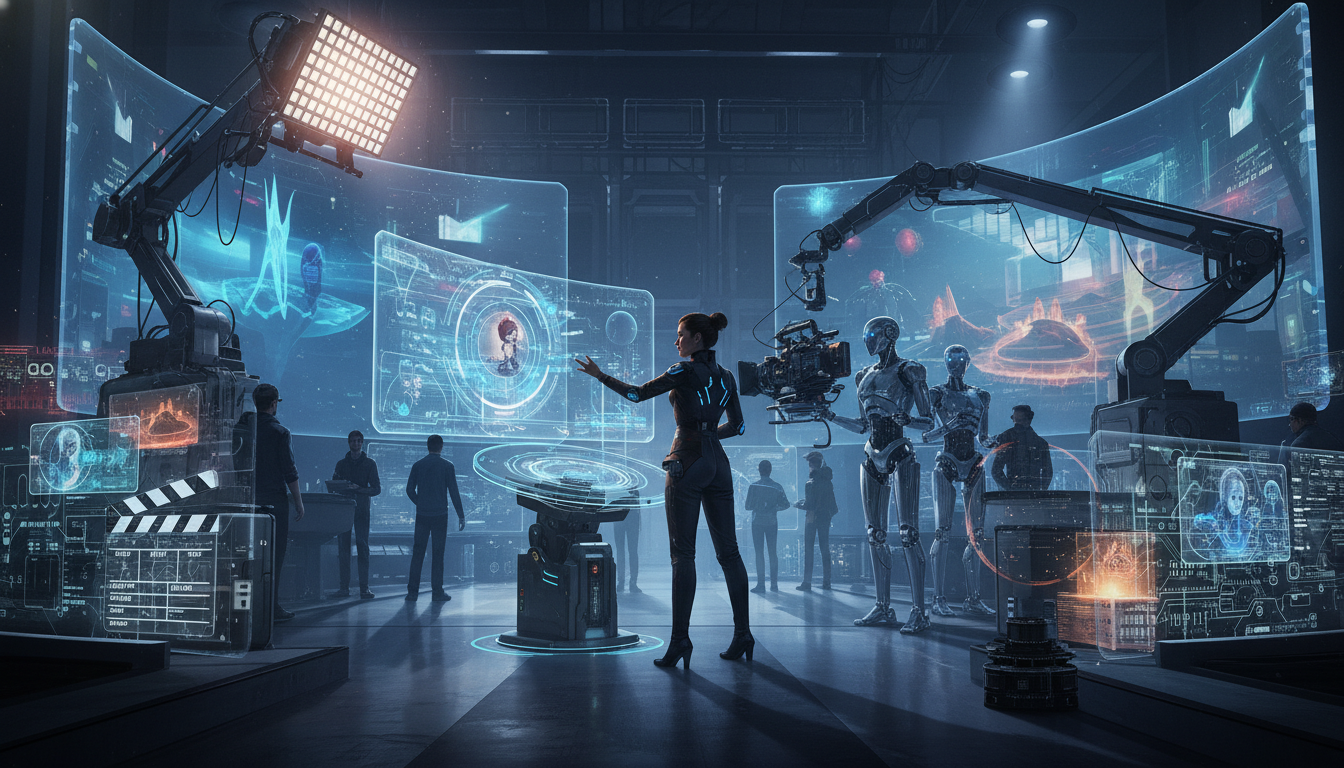
AI in Cinema: The Creative Revolution on the Big Screen
The glow of big and small screens has always captivated us, transporting us to unimaginable worlds. Now, prepare to see these universes expand in ways you never imagined, thanks to a transformative force: Artificial Intelligence. For technology enthusiasts, visionary filmmakers, and all who dream of the future of entertainment, the arrival of AI in cinema and TV is not just a novelty, it’s a creative revolution in full swing, redefining the limits of narrative and audiovisual production. Click to explore the behind-the-scenes of this innovation!
AI in Cinema: Optimizing Every Stage of Production
The production of a film or series is a complex orchestra, with hundreds of instruments and maestros working in unison. Artificial Intelligence is becoming an indispensable tool, optimizing processes and freeing creators to focus on what truly matters: the art of storytelling.
From Pre-production to Post: Where AI Transforms
From the initial spark of an idea to the polished final scene, AI in cinema is redefining the workflow. In pre-production, algorithms analyze scripts to identify success patterns, predict audience engagement, and even generate suggestions for dialogues or character arcs. Imagine a system that helps refine the complex mythology of a science fiction universe, ensuring consistency and impact. In planning, AI optimizes schedules, budgets, and even suggests the most suitable locations based on visual and logistical data, ensuring that every resource is employed with maximum efficiency.
When filming begins, AI can assist in managing virtual sets, camera calibration, and even performance analysis to identify the best takes. After recording, in post-production, its impact is even more visible.
Visual and Sound Effects: Redefining the Impossible
Visual effects (CGI) are where AI in cinema shines intensely. Fantastic creatures, lush landscapes, and action sequences that defy physics can be generated and enhanced with unprecedented speed and realism. AI tools accelerate rendering, improve textures, and allow precise digital retouches that previously would have taken hours of manual work. Think of an emerging filmmaker creating a futuristic car chase scene with effects worthy of major studios, using AI to convincingly simulate collisions and explosions.
In the sound realm, Artificial Intelligence composes original musical scores that adapt dynamically to the narrative, manages sound design to create immersive sonic environments, and even assists in dubbing and lip-syncing, ensuring that emotion transcends the language barrier. A fan of games and cinema can experience a soundtrack that evolves in real-time with the plot’s twists, something AI makes perfectly possible.
The New Frontier of Narrative with Artificial Intelligence
Beyond technical optimization, AI is opening new horizons for the very art of storytelling, offering tools to explore narratives in innovative ways.
Synthetic Characters and Enhanced Performance
AI enables the creation of hyper-realistic digital characters, indistinguishable from human actors. Not just for de-aging or recreating iconic performances, but for bringing entirely new avatars to life that can perform in various scenarios. This opens doors for stories set in worlds where the boundary between the real and the digital is thin, something the geek and science fiction audience will love to explore.
Personalization and Immersive Experiences
Imagine a film that adapts to your preferences in real-time, or a series where your choices change the course of the story. AI makes adaptive content possible, offering personalized experiences that deepen viewer immersion. This interactive engagement capability is the next evolution of entertainment, allowing the audience to become an integral part of the narrative, exploring unique paths with each viewing.
Challenges and the Human-AI Future
The rise of AI in cinema raises important questions, but the message is clear: Artificial Intelligence is a tool that enhances human creativity, not replaces it. It frees artists from repetitive tasks, allowing them to invest more energy in artistic vision and innovation. The future of entertainment will be a harmonious collaboration between human intuition and AI’s analytical capabilities, paving the way for even more impactful and original works.









Post Comment