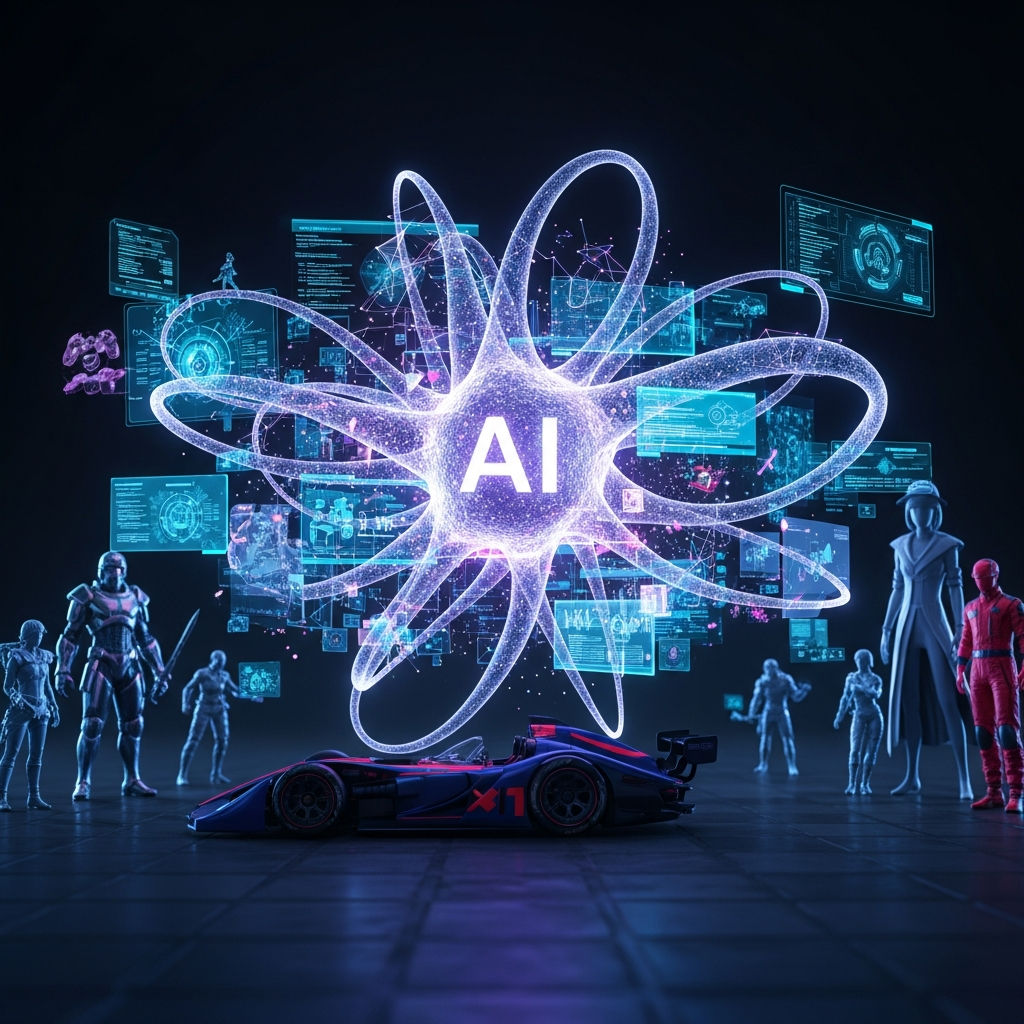
AI in Games: The Future of Development and Experience in 2026
The universe of electronic games is on the brink of an unprecedented transformation, exponentially driven by Artificial Intelligence. By 2026, AI will not just be an auxiliary tool, but the pulsating heart of game development, redefining every aspect, from conception to player immersion. For developers, enthusiastic gamers, analysts, and investors, understanding this scenario is crucial for navigating and capitalizing on the future of games with AI.
The AI Revolution in Game Development
AI game development is evolving rapidly, promising more efficient processes and the creation of more complex and responsive digital worlds. AI’s ability to process large volumes of data and learn patterns is optimizing tasks that previously demanded significant time and human resources.
Process Optimization with AI Game Development
AI application ranges from automating quality assurance tests, identifying bugs and flaws with surprising accuracy, to generating graphic assets and textures. AI-based tools can, for example, analyze player feedback in real time to suggest adjustments in level design or gameplay balancing, allowing teams to focus on creativity and innovation. AI Game Development accelerates production cycles and elevates the quality of the final product.
Enhanced Procedural Content Generation
Generative AI is taking procedural content creation to a new level. Instead of repetitive worlds, we see dynamic environments that adapt and evolve. Imagine an RPG where forests grow organically, rivers change their course based on AI-simulated weather events, and quests are intelligently generated, ensuring each journey is unique. This is the promise of the Future of Games with AI, where variety and surprise are constant.
Enhancing Player Experience with AI in Games
Beyond the backstage, AI in games has a direct and profound impact on how players interact and engage with virtual worlds. Immersion becomes deeper, and personalization, more sophisticated.
Intelligent NPCs and Dynamic Worlds
No more predictable NPCs. With AI, non-playable characters acquire more realistic and adaptable behaviors. They learn from player actions, develop personalities, and even form memories, impacting their future interactions. In a battle scenario, enemies with advanced AI can coordinate tactical attacks, flank, and use the environment to their advantage, transforming each confrontation into a genuine strategic challenge. The game world, in turn, can react more organically to player choices, creating an emergent and personalized narrative.
Personalization and Adaptation in Experience
AI in games allows the experience to be tailor-made for each individual. Algorithms can analyze the player’s playstyle, preferences, and even emotional state to adjust difficulty, suggest relevant content, or adapt interface elements. A game can, for example, intensify its horror atmosphere if it detects that the player enjoys scares or offer more complex puzzles if they demonstrate aptitude. This adaptability raises the level of engagement and longevity of titles.
Innovative Accessibility with AI
Inclusion is a fundamental pillar in the Future of Games with AI. AI-based systems can offer accessibility features never before imagined, such as dynamic subtitles that adjust to speech speed, intelligent aiming assistants for players with motor difficulties, or even detailed audio descriptions of visual scenes. AI in games is making games more accessible to a wider audience, breaking barriers and enriching the community.
AI Gaming Trends 2026: A Look at the Future of Games with AI
AI Gaming Trends 2026 point to a scenario where human-AI collaboration will become the norm, and ethics in implementation will be central.
Generative AI and New Possibilities
Generative AI is not limited to environment creation. It is being explored to generate scripts, dialogues, music, and even entire game concepts, accelerating the prototyping and experimentation phase. This opens doors for unprecedented creativity, where small teams can develop massive and complex experiences.
Challenges and Ethics in AI in Games
With great advances come great responsibilities. Ethical questions about AI bias, player data privacy, and the impact on developer employment are relevant discussions. Ensuring that AI is used responsibly and transparently is crucial for the sustainability of innovation in AI Game Development.
The Role of Data and Machine Learning
AI’s ability to learn and refine itself intrinsically depends on large volumes of data. Machine learning will be the backbone for systems that predict player behavior, optimize monetization in a non-intrusive way, and create truly dynamic experiences. Understanding and applying these principles is vital for those seeking to master the AI Gaming Trends 2026.














Post Comment