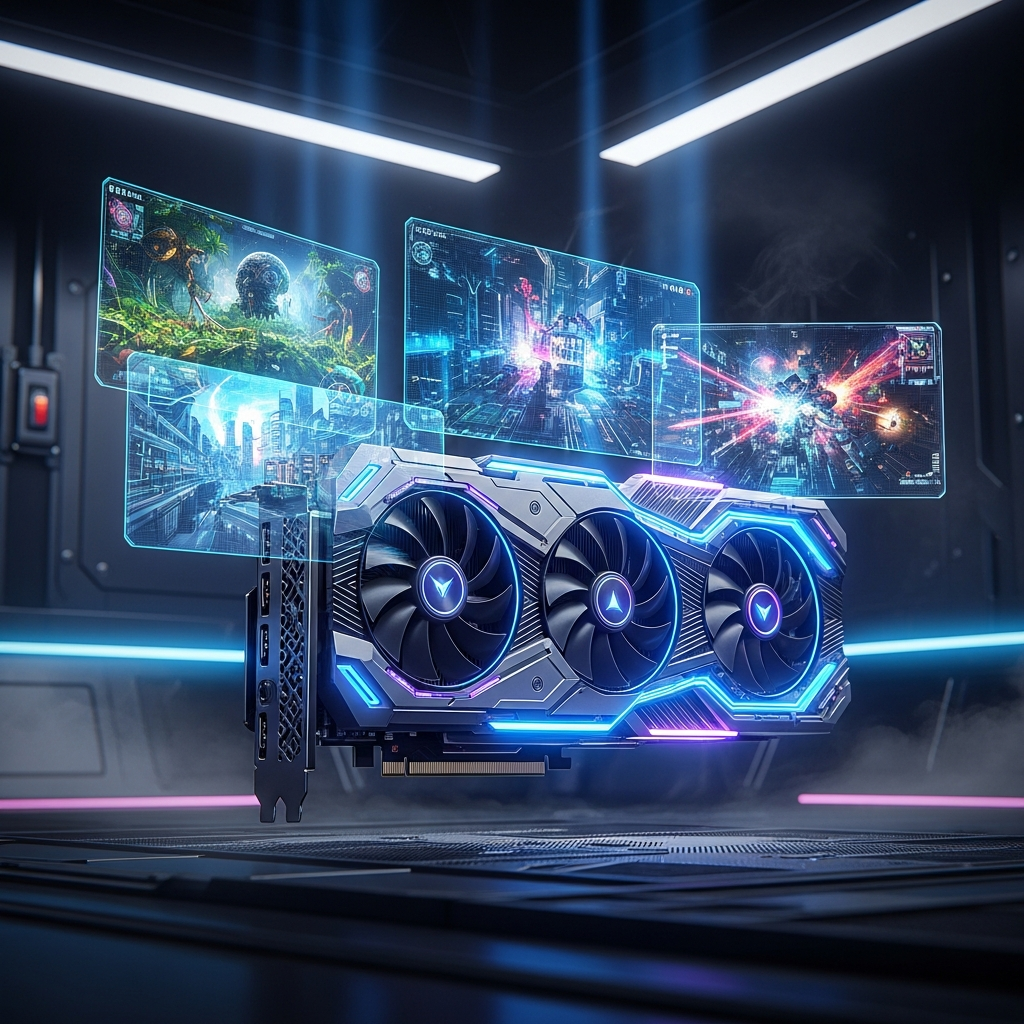
High-Performance GPUs: The Future of Gaming Hardware | Realism
The universe of gaming and digital creation is constantly buzzing, driven by an insatiable desire for more realism, fluidity, and innovation. With each new generation, GPUs reinvent themselves, pushing the boundaries of what is visually possible. Prepare to understand how the evolution of high-performance GPUs is not just improving gaming hardware, but completely redefining immersion and creative potential.
The New Generation: The Power Behind Extreme Realism
The relentless pursuit of more authentic graphics has led to the creation of revolutionary GPU architectures. We are witnessing the rise of technologies that transform every pixel into a window to a virtual world almost indistinguishable from reality. Innovations in shader processing units, RT Cores, and Tensor Cores are the backbone of this metamorphosis, raising the standard for all gaming hardware.
Ray Tracing and Path Tracing: Light in the Gaming Era
The realism of lighting and reflections has always been a challenge in real-time graphics. With the advent of hardware-accelerated Ray Tracing, and the subsequent exploration of Path Tracing, light simulation has become incredibly precise. Gamers can now experience worlds where every light source, shadow, and reflection behaves in a physically correct manner, creating atmospheres that were previously unattainable in games like Cyberpunk 2077 or Alan Wake 2, where visual depth is paramount.
Super-Resolution and AI: Performance and Quality United
To ensure these complex graphics run smoothly at high resolutions, AI-powered super-resolution technologies, such as NVIDIA’s DLSS, AMD’s FSR, and Intel’s XeSS, have become indispensable. They allow high-performance GPUs to render images at a lower resolution and scale them to the screen’s native resolution with surprising quality, freeing up resources for more frames per second or even greater visual details. This means that even the most demanding titles can be enjoyed with the best of both worlds: stunning visuals and impeccable performance, a true differentiator for modern gaming hardware.
More Than Pixels: Innovation in Gaming Hardware
Behind the graphic processing power, there is a complex ecosystem of components working in harmony. Modern GPUs do not rely solely on their processing cores; memory infrastructure, bandwidth, and energy efficiency are equally crucial to unlock true performance potential and deliver a superior experience in gaming hardware.
Memory and Bandwidth: The Essential Data Flow
With 4K textures, complex 3D models, and expansive worlds, the quantity and speed of video memory (VRAM) are more important than ever. The latest architectures employ memories like GDDR6X, which offer massive bandwidth, allowing the GPU to access and manipulate large volumes of data almost instantly. This is vital to avoid bottlenecks and ensure that the rendering of detailed and dynamic scenes is fluid, whether playing games or editing high-resolution videos, optimizing the capability of high-performance GPUs.
Energy Efficiency and Cooling: The Balance of Power
Increased processing power inevitably comes with increased energy consumption and heat generation. The next generation of high-performance GPUs is constantly innovating in power management designs and advanced cooling solutions. More robust cooling systems, such as triple-fan coolers and vapor chambers, along with chip-level optimizations, ensure that these cards can operate at their peak performance for long periods without overheating, maintaining the stability and longevity of gaming hardware.
The Impact on Experiences: Gaming and Creation
Ultimately, all these innovations converge to a single point: radically enhancing the user experience. Whether for gamers seeking maximum immersion or for creators demanding powerful tools, high-performance GPUs are at the heart of this transformation.
Total Immersion: Games That Overflow the Screen
Forget the visual limits of the past. With current capabilities, games are becoming increasingly cinematic experiences. Every detail, from raindrops on a window to the shine of metallic armor, is rendered with impressive fidelity. Titles like Microsoft Flight Simulator with its hyper-realistic scenarios or Starfield with its vast explorables universes directly benefit from these cards, offering a level of immersion that previously only existed in science fiction for the gaming hardware enthusiast.
Creation Tools: Acceleration and Workflow
For content creators, whether 8K video editors, 3D artists, or game developers, high-performance GPUs are indispensable tools. Hardware acceleration in software like Adobe Premiere Pro, Blender, or DaVinci Resolve means faster renders, complex real-time simulations, and instant previews. This not only optimizes the workflow but also allows for more ambitious creative experiments, opening new doors for innovation and productivity in the professional gaming hardware environment.














Post Comment