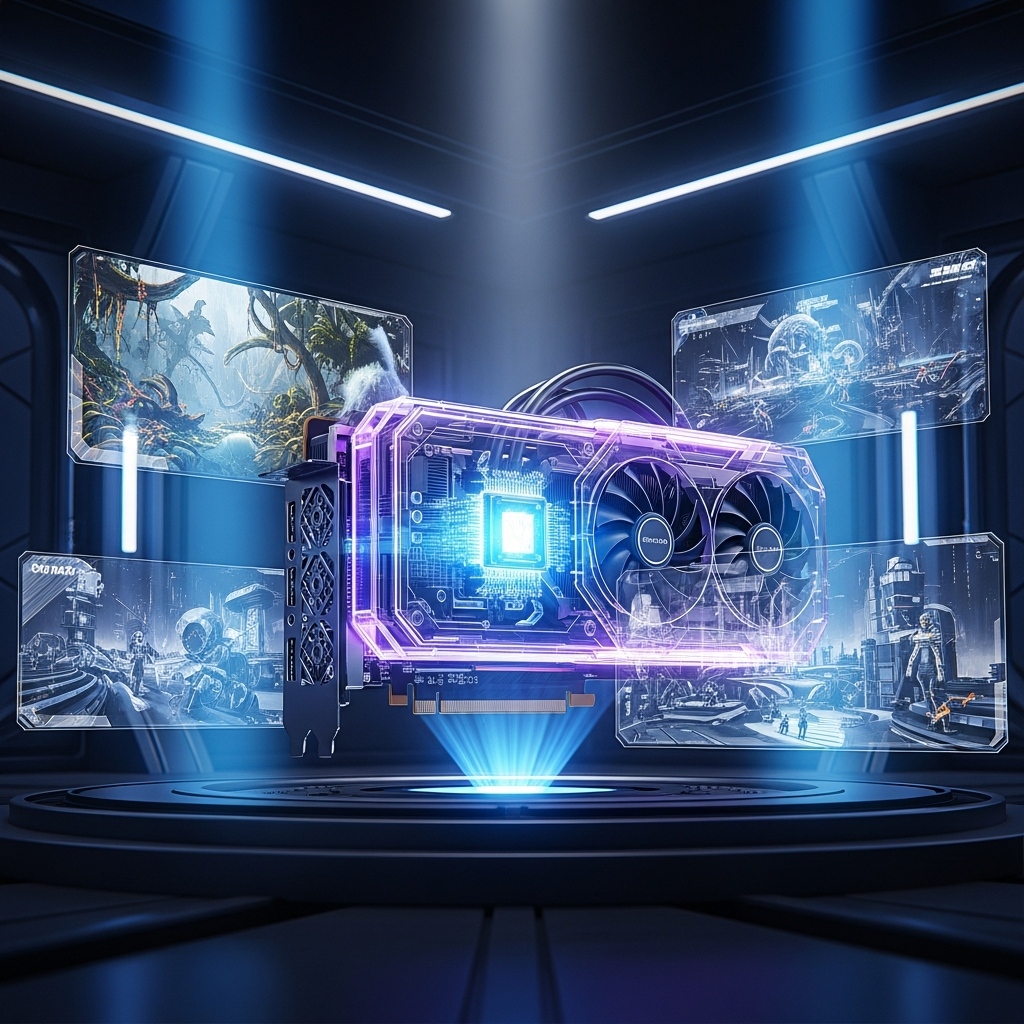
The Evolution of High-Performance GPUs for Gamers
The gaming universe is constantly evolving, and at the center of this technological transformation, high-performance GPUs stand out as the true engines of innovation. Forget what you knew about graphics; the next generation of video cards is redefining the limits of what’s possible, delivering a level of realism and immersion that once seemed reserved for science fiction. For tech enthusiasts, gamers seeking unparalleled performance, and content creators, understanding these innovations is crucial to unlocking the future of gaming hardware.
The Visual Revolution: Ray Tracing and Global Illumination
The greatest proof of the evolution of high-performance GPUs is their ability to process Real-Time Ray Tracing. This rendering technique simulates the physical path of light, resulting in incredibly realistic lighting, shadows, and reflections that completely transform the atmosphere of games. Imagine the precise reflections in puddles of water in “Cyberpunk 2077” or the dynamic and volumetric lighting in “Alan Wake 2”, where each light source behaves exactly as in the real world. For the player, this means deep immersion; for the content creator, it represents a powerful tool for more authentic renders and breathtaking visuals.
The Impact on Realism and Player Experience
Modern GPUs, with their dedicated RT Cores, elevate photorealism to unprecedented levels. Every detail, from the subtle sheen of a metallic surface to the way light diffuses through a window, is rendered with a precision that blurs the line between the virtual and the real. This not only makes game worlds more believable but also intensifies the player’s emotional connection with the environment and narrative, an indispensable differentiator for the gaming hardware enthusiast.
More FPS and Quality: Smart Upscaling with AI
To keep up with the visual leap, Artificial Intelligence-based upscaling technologies, such as NVIDIA’s DLSS, AMD’s FSR, and Intel’s XeSS, have become pillars of next-gen gaming hardware. They allow the game to be rendered at a lower resolution and then use AI to reconstruct the image to a higher resolution, resulting in massive performance gains without compromising visual quality. This means you can enjoy games in 4K or ultrawide resolutions with fluid frame rates, even in the most demanding titles.
Redefining the Limits of Fluidity and Detail
These technologies are a game-changer for those seeking the most from their high-performance GPUs. They ensure that developers’ visions for richly detailed worlds full of complex visual effects can be fully experienced, without performance bottlenecks. Image fluidity, crucial for responsiveness and satisfaction in gameplay, is maintained, allowing every movement and interaction to be processed with precision and without interruptions, a dream for any gamer who values cutting-edge gaming hardware.
Integrated AI and Machine Learning: Beyond Graphics
Artificial Intelligence in high-performance GPUs goes far beyond upscaling. It is being integrated to optimize textures in real-time, improve physical simulations of objects and environments, and even enhance the artificial intelligence of non-playable characters (NPCs). Imagine enemies with more adaptive behaviors or environments that react more organically to your actions.
Optimization and Dynamic Experiences
This deep integration of AI allows gaming hardware not only to process graphics but also to create more dynamic and responsive worlds. The ability to predict behaviors and optimize resources in real-time results in a more cohesive and immersive gaming experience, where every element of the environment contributes to the feeling of a living, pulsating world. It’s AI working behind the scenes to further enhance your immersion.
VRAM and Bandwidth: The Key to Complex Textures and Scenarios
With the increase in visual fidelity, the need for VRAM (video memory) in high-performance GPUs has become more critical than ever. Modern 4K games, with ultra-high-resolution textures and vast scenarios, require a large amount of memory to store all this data. Memory bandwidth is also vital, ensuring that the GPU can access this data quickly. For content creators working with rendering complex 3D models or high-resolution video editing, abundant VRAM is an absolute prerequisite.
Ensuring Immersion in Detailed Worlds
Generous and high-speed VRAM is crucial to avoid bottlenecks and ensure that immersion is not broken by slow-loading textures or performance drops. It allows next-generation games to load all the assets and visual details that contribute to a convincing world, without compromise. For the enthusiast, this means sharp and detailed graphics at all times, maximizing the potential of gaming hardware.
Innovative Architectures and Advanced Cooling Systems
Behind all this power are meticulously designed GPU architectures that optimize each core for maximum performance. But to sustain this power, efficient cooling systems are indispensable. Solutions like vapor chambers, multiple fans, and massive heat sinks are developed to keep temperatures under control, ensuring that high-performance GPUs operate at their peak for hours on end, without compromising longevity or performance.
Sustaining Extreme Performance
Cutting-edge gaming hardware demands a thermal design that is not only effective but also intelligent. This allows enthusiasts and content creators to explore the full potential of their graphics cards without worrying about overheating or “throttling.” It is the engineering behind sustained performance that truly differentiates high-performance GPUs, allowing you to dive into your favorite virtual worlds with complete confidence and without interruptions.














Post Comment