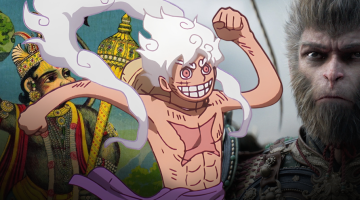
Luffy’s New Monkey Form: Sun Wukong & Hanuman Roots for Otaku
The world of One Piece, crafted by the visionary Eiichiro Oda, constantly surprises and delights its global fanbase with intricate plots, unexpected twists, and profound character developments. For the dedicated Otaku, every new chapter is a treasure trove of potential theories, and Chapter 1198 proved to be no exception. As Monkey D. Luffy, the indefatigable captain of the Straw Hat Pirates, pushed the boundaries of his Gear 5 to an unprecedented degree, the consequences were nothing short of astonishing: a dramatic, almost primal transformation that left him with black hair, a distinct tail, sharp fangs, and unmistakable monkey-like features.
This startling evolution immediately sent shockwaves through the fandom, sparking fervent discussions across forums and social media. What did this new form signify? Was it a temporary side effect, or a permanent shift in his powers? More importantly, what ancient legends and mythologies might be at play? Fans were quick to draw parallels to two of the most iconic simian figures in global folklore: Sun Wukong, the legendary Monkey King from the classical Chinese novel ‘Journey to the West,’ and Hanuman, the revered monkey deity from Hindu mythology. While Eiichiro Oda himself has yet to confirm any direct inspirations, the thematic, visual, and even linguistic coincidences are compelling enough to warrant a deep dive.
This exploration goes beyond mere superficial resemblances. It delves into the narrative implications, the historical context of these myths, and how Oda, known for his masterful storytelling, might be weaving these ancient threads into the very fabric of One Piece‘s expansive universe. For the discerning Otaku, understanding these potential mythological underpinnings doesn’t just enrich the reading experience; it offers a new lens through which to appreciate the genius of a manga that consistently transcends conventional boundaries. Prepare to uncover the fascinating connections that could redefine our understanding of Luffy’s journey and his ultimate destiny.
The Astonishing Transformation: Luffy’s Primal Awakening for the Modern Otaku
Luffy’s new monkey-like form, triggered by pushing Gear 5 beyond its typical limits, is a dramatic manifestation featuring black hair, a tail, fangs, and pronounced simian traits, immediately drawing connections to legendary monkey figures in global folklore for observant fans.
In Chapter 1198, the intense demands placed on Luffy’s body by his Gear 5 ability, a state already recognized for its rubberized freedom and boundless imagination, seemingly forced an even deeper metamorphosis. This wasn’t merely a stylistic alteration; it represented a fundamental shift in his appearance, one that resonated deeply with archetypal imagery. The emergence of these distinct monkey characteristics signaled a powerful, perhaps even ancestral, aspect of his devil fruit awakening or lineage.
This unprecedented transformation immediately captivated the attention of the global Otaku community. The visual cues were striking and undeniable, prompting an outpouring of theories linking Luffy to famous mythical simians. It underscored how One Piece consistently taps into a collective unconsciousness, utilizing familiar mythological frameworks to build upon its unique narrative. The immediate recall of figures like Sun Wukong and Hanuman highlights the cultural literacy of the fanbase and their keen eye for detail.
The significance of this form extends beyond its visual novelty. It raises questions about the true nature of Luffy’s Devil Fruit, the Hito Hito no Mi, Model: Nika, and whether this monkey-like state is a previously unseen aspect of the Sun God Nika or an entirely new, distinct evolutionary stage. This ambiguity fuels the speculative fervor, keeping fans on the edge of their seats as they anticipate Oda’s next revelation.
Sun Wukong: The Enduring Legacy of the Monkey King for the Discerning Otaku
Sun Wukong, the iconic Monkey King from the Chinese epic ‘Journey to the West’, is widely theorized to be a profound inspiration for Luffy’s new form, with parallels in rebellion against deities, westward journeys, linguistic connections to the ‘Monkey’ name, and thematic echoes of challenging divine authority.
The classic 16th-century Chinese novel, ‘Journey to the West,’ has left an indelible mark on popular culture worldwide, famously inspiring works like ‘Dragon Ball,’ where Son Goku is a Japanese rendition of Sun Wukong. For many Otaku, it’s not a stretch to suggest that parts of One Piece, particularly the Wano arc, also draw from this rich narrative tapestry. Sun Wukong’s tale is one of defiant rebellion: he challenged the gods of Chinese folklore, endured 500 years of imprisonment under a mountain by the Buddha, and subsequently protected a monk on a perilous journey to the west.
These narrative beats find striking resonance with Luffy’s own saga. Like Wukong, Luffy’s ultimate dream involves challenging the established “gods” of his world, primarily the World Nobles and Imu. The detail that Luffy moves from his battlefield to Elbaf’s western village after his transformation further reinforces this comparison to the ‘Journey to the West,’ suggesting a metaphorical or literal westward journey.
The connection deepens beyond thematic parallels to linguistic subtleties. Characters within One Piece often describe those with the initial “D.” as “enemies of the gods,” a description that aligns perfectly with Sun Wukong’s divine defiance. Moreover, the most famous family bearing this “D.” is, notably, the Monkeys. In Mandarin, the word for “monkey” was once 猢猻 (húsūn), where “Sun” (孫) translates to “grandchild” or “descendant.” This could subtly allude to Luffy being the grandson of a “Monkey” (Garp) and a symbolic descendant of Nika, who is depicted as a third “savior” following Joy Boy.
Adding another layer, some fans propose that “Sun” also serves as a clever pun on the English word for “sol,” connecting directly to the Sun God Nika, a pivotal figure in One Piece lore, and Luffy’s ultimate identity. While Luffy isn’t a traditional shapeshifter like Wukong, his attacks frequently mimic animals or objects, from a snake and rhinoceros to a gorilla, pistol, bazooka, and axe, showcasing a versatile, adaptable combat style reminiscent of Wukong’s varied abilities.
Echoes of Rebellion: Luffy’s Fight Against Divine Authority
Sun Wukong’s narrative arc is fundamentally built upon his audacious defiance of the celestial hierarchy, a theme that mirrors Luffy’s intrinsic drive to dismantle oppressive systems and liberate people from the clutches of those who wield power under the guise of divinity.
The D. clan, often referred to as ‘God’s natural enemy’ by various characters, encapsulates this rebellious spirit, positioning Luffy and his lineage in a direct ideological conflict with the World Nobles, who view themselves as divine rulers. This parallel between Wukong’s challenge to the Jade Emperor and Luffy’s eventual confrontation with the World Government’s enigmatic leader, Imu, is a narrative cornerstone that elevates One Piece beyond a simple adventure story, anchoring it in a profound struggle for freedom and justice, a concept deeply cherished by every Otaku.
“Sun” and the Legacy of “Monkey”: A Linguistic Dive for Otaku
The linguistic play around the name “Monkey” in One Piece, particularly with the character “Sun” (孫), offers a clever, multi-layered connection to Sun Wukong’s legacy and Luffy’s role as a descendant.
The traditional Chinese character for ‘Sun’ (孫), meaning ‘grandchild’ or ‘descendant’, ties directly into Monkey D. Garp being Luffy’s grandfather. Simultaneously, the phonetic similarity of ‘Sun’ to ‘sol’ (sun in English) subtly links Luffy to the Sun God Nika, whose name and symbolism are increasingly central to the narrative, providing an enriching layer for any detail-oriented Otaku analyzing the series’ deeper meanings.
Hanuman: The Hindu Deity and His Unmistakable Mark on Luffy’s Powers, a Treat for Every Otaku
Hanuman, the Hindu monkey god, presents another compelling parallel to Luffy’s new form, evident through his association with the wind god Vayu (linking to Dragon’s powers), the legend of trying to consume the sun, boundless physical strength, size-altering abilities, and a direct naming reference in Luffy’s ‘Bajrang Gun’ attack.
Beyond the realm of Chinese folklore, Hindu mythology offers the formidable figure of Hanuman, the revered monkey god, whose attributes remarkably align with aspects of Luffy’s character and his recent transformation. Hanuman is famously known as the son of Vayu, the god of wind. This connection immediately sparks recognition for fans of One Piece, as Luffy’s own father, Monkey D. Dragon, commands powers over the wind, establishing a familial link that could extend to Luffy himself.
A key legend surrounding the young Hanuman tells of his attempt to eat the Sun, mistaking it for a ripe fruit. In response, Indra struck him with a thunderbolt, causing him to fall and break his jaw. This myth resonates powerfully within One Piece, especially with the introduction of Nika as the Sun God. Fan theories suggest Oda might be playing with the idea of Nika “eating the Sun,” perhaps connecting to the mysterious Mother Flame, which the narrative associates with the sun, or the ancient history of the First World, where humans touched a “forbidden sun” before the Sun God appeared to grant slaves their freedom.
Hanuman’s inherent abilities further strengthen the comparison. He possesses limitless physical strength, an attribute synonymous with Luffy’s combat prowess. Moreover, Hanuman has the power to change his size at will, shrinking to the size of an insect or growing larger than a mountain – a feat reminiscent of Wukong’s magical staff and, more broadly, the expansive and adaptable nature of Luffy’s Gear abilities. Perhaps the most direct homage comes with Luffy’s Gear 5 attack, the ‘Bajrang Gun,’ which directly references one of Hanuman’s titles, Bajrangbali. Many ancient illustrations of Hanuman also depict him with a snout similar to the one seen in Luffy’s transformed state, providing a striking visual concordance for the perceptive Otaku.
The Sun Devourer: Nika, Mother Flame, and Ancient Prohibitions
The tale of Hanuman attempting to consume the sun finds compelling, albeit speculative, parallels within One Piece lore through Nika, the Sun God, and the enigmatic Mother Flame, hinting at a forgotten history of cosmic significance.
The fan theory that Nika “ate the Sun” could explain the Mother Flame’s connection to the sun and the “forbidden sun” touched by humans in the First World, suggesting a foundational myth about the origins of power and freedom in the world of One Piece. This narrative thread, if confirmed, would intertwine Luffy’s destiny as Nika’s successor with ancient celestial events, enriching the overarching mythology for every eager Otaku.
Imu and the “Broken God”: Unraveling the Antagonistic Parallel for the Curious Otaku
Imu, the enigmatic ruler of the World Government, is theorized to embody a “Broken God” or “Broken Buddha,” providing a stark philosophical and narrative counterpoint to Luffy’s Sun Wukong/Hanuman parallels, symbolizing a corrupt divine authority that subverts genuine spiritual ideals.
The shadowy figure of Imu, the true sovereign of the World Government, has become a focal point for deep theoretical analysis within the One Piece community. Many speculate that Imu draws inspiration from a diverse range of cultures, particularly Buddhism and Christianity, creating a complex antagonist whose nature remains largely shrouded in mystery. One prominent fan theory suggests that the two characters forming Imu’s name (イム) can be superimposed to create the kanji 仏 (hotoke), which means “Buddha.” This visual and linguistic overlap leads to the intriguing concept of Imu as a “Broken God” or “Broken Buddha,” embodying a perverted or corrupted form of divine power.
Further supporting this theory is the imagery surrounding the Empty Throne, the most prominent throne in the One Piece world, located in Mary Geoise. This throne strikingly resembles the “empty throne” often used in ancient Buddhist art to represent the Buddha in an aniconic form, symbolizing his presence without depicting an image, and signifying the interconnectedness of all people rather than the dominion of a single ruler. The Empty Throne in One Piece is meant to represent that no single entity rules the world, but rather an assembly of nations, implying equality and shared governance.
Imu’s deliberate act of sitting upon this very throne, which should remain unoccupied, becomes a profound subversion of this powerful ideal. If the analogy holds true, then the narrative potential of Luffy, embodying the rebellious spirit of the Monkey King, confronting Imu, the “Broken Buddha,” creates a compelling parallel that is almost impossible to ignore. This philosophical confrontation elevates the story from a simple battle of good versus evil to a clash of ancient spiritual ideals, a depth that truly captivates the intellectual Otaku.
The Interplay of Myth and Manga: Why These Connections Resonate with Every Otaku
The intricate weaving of global myths into One Piece by Eiichiro Oda deepens its narrative, allowing fans to discover hidden layers of meaning and cultural references, which significantly enriches their appreciation and understanding of the series’ epic scope.
Eiichiro Oda’s masterful ability to synthesize diverse cultural mythologies, historical events, and literary references into the unique world of One Piece is a cornerstone of its enduring appeal. For the dedicated Otaku, uncovering these hidden connections to figures like Sun Wukong and Hanuman is not merely an intellectual exercise; it’s a profound enhancement of their engagement with the narrative. These layers transform the manga from a simple adventure story into a rich tapestry of global folklore, demonstrating Oda’s vast creative breadth.
These theories resonate so strongly because they provide a sense of continuity and depth, suggesting that Luffy’s journey is not just an arbitrary path but one guided by echoes of ancient heroism and divine rebellion. The recognition of these figures allows fans to predict potential plot developments, understand character motivations on a deeper level, and appreciate the subtle genius behind Oda’s world-building. It fosters a vibrant community of theorists and analysts, constantly seeking to unravel the next great mystery.
Furthermore, the incorporation of such revered mythological figures grants One Piece a universal appeal, bridging cultural divides by tapping into shared human experiences of struggle, freedom, and destiny. It elevates the Straw Hat Pirates’ quest into something timeless and archetypal, ensuring that the saga continues to be discussed, debated, and adored by generations of fans worldwide. This ongoing discovery of meaning is precisely what makes One Piece a generational masterpiece for any serious Otaku.
| Aspecto | Monkey D. Luffy (Nova Forma) | Sun Wukong (Rei Macaco) | Hanuman (Deus Macaco) |
|---|---|---|---|
| Aparência | Cabelo preto, cauda, presas, traços de macaco | Macaco imortal, corpo dourado, olhos de fogo, bastão mágico | Macaco musculoso, rosto vermelho, forte, empunha maça |
| Natureza Principal | Capitão pirata, usuário de Akuma no Mi, busca liberdade | Rei de macacos, metamorfo, rebelde, guardião | Deus hindu, servo fiel, filho do deus do vento |
| Poderes e Habilidades | Elasticidade (Gear 5), ataques que imitam animais/objetos, Haki | Imortalidade, 72 transformações, super força, velocidade, bastão ‘Ruyi Jingu Bang’ | Força ilimitada, muda de tamanho, velocidade, capacidade de voar, Bajrangbali |
| Conflito Central | Contra “deuses” (Nobre Mundial, Imu), busca a liberdade | Desafiou os deuses celestiais, aprisionado pelo Buda | Enfrentou demônios, tentou comer o Sol, serve a Rama |
| Associações | Nika (Deus do Sol), Família “Monkey” D., “inimigo dos deuses” | Jornada ao Oeste, “Neto” (Sun), Buda | Vayu (deus do vento), Bajrang Gun (ataque), o Sol |
| Linguagem/Puns | “Monkey” (família), “Sun” (sol/descendente), Bajrang Gun | “Sun” (孫 – neto/descendente), Húsūn (猢猻 – macaco) | Bajrangbali (título, ligação com Bajrang Gun) |
Curiosidades e Futuras Implicações para o Fã de One Piece Otaku
The ongoing theoretical debate around Luffy’s monkey form and its mythological roots opens fascinating avenues for understanding One Piece‘s future, suggesting deeper narrative layers and potential plot twists that will continue to engage the dedicated Otaku.
One of the most intriguing aspects arising from these theories is the concept of a cyclical narrative. If Luffy truly embodies aspects of both Sun Wukong and Hanuman, then his journey might be destined to mirror their legendary paths in unforeseen ways. This could imply future encounters with characters who represent the ‘Buddha’ figure, as Imu is theorized to be, or even a more literal ‘journey to the west’ within the grand line. The fact that Oda intentionally places Luffy’s transformation around Elbaf’s western village is a detail too precise to be mere coincidence for many.
Another curiosity lies in the potential revelation of the D. clan’s true origins. If “Monkey” and “Sun” carry such deep semantic weight, could the entire lineage of the Monkeys, and indeed all bearers of the D. initial, be rooted in ancient mythical figures? This would dramatically reframe the history of the world in One Piece, connecting ancestral figures directly to mythological archetypes. The implications for characters like Monkey D. Garp, Monkey D. Dragon, and even Portgas D. Ace are immense, hinting at a heritage far grander than previously imagined.
Furthermore, the ‘Sun’ connection to Nika and the ‘Mother Flame’ suggests a primordial conflict or event that reshaped the world. Could the legends of Hanuman attempting to eat the sun be a metaphor for a cataclysmic event involving Nika or an ancient power source? This could lead to uncovering the true history of the Void Century, the Ancient Weapons, and the very nature of the World Government’s power. For the devoted Otaku, these possibilities are not just entertaining; they are central to unlocking the ultimate mysteries of One Piece, promising a future filled with even more profound revelations and epic storytelling.
FAQ: Exploring the Depths of Luffy’s Monkey Form and Its Mythological Echoes
Q: What specifically prompted Luffy’s new monkey-like form in One Piece?
A: Luffy’s new monkey-like form emerged in Chapter 1198 after he pushed his Gear 5 transformation to extreme limits. This intense exertion seemingly triggered a deeper, more primal awakening within his Hito Hito no Mi, Model: Nika Devil Fruit. Unlike his previous Gear forms which are largely controlled, this latest manifestation appears to be a reactive, perhaps involuntary, evolution of his power, underscoring the immense physical and spiritual toll of overusing his most potent ability. It signifies not just a change in appearance but a potential unlocking of an ancestral or latent power associated with the Sun God Nika, whose identity itself is deeply rooted in liberation and mythological symbolism. This moment hints at the vast, unexplored potential and risks inherent in fully awakening a mythical Zoan fruit.
Q: How do fans connect Luffy’s form to Sun Wukong from ‘Journey to the West’?
A: Fans draw numerous parallels between Luffy’s new form and Sun Wukong, the Monkey King. Both figures embody rebellious spirits, challenging divine authority and seeking freedom. Sun Wukong famously defied the gods and was imprisoned, a narrative echoing Luffy’s continuous fight against the World Nobles. The journey to the west in Wukong’s tale is also mirrored by Luffy moving to Elbaf’s western village. Furthermore, linguistic connections exist: the “Monkey” in Luffy’s name and the “Sun” (孫) in Chinese, meaning grandchild or descendant, link to Wukong. Luffy’s diverse fighting style, mimicking various animals and objects, also recalls Wukong’s metamorphic abilities. These connections suggest a deliberate homage by Oda, enriching Luffy’s character with legendary depth.
Q: What are the primary connections between Luffy and the Hindu deity Hanuman?
A: The connections between Luffy and Hanuman are compelling. Hanuman is the son of Vayu, the god of wind, which draws a direct parallel to Luffy’s father, Dragon, who possesses wind-based powers. The legend of child Hanuman attempting to eat the Sun is particularly relevant given Nika’s identity as the Sun God, suggesting a deeper lore regarding the sun within One Piece. Hanuman’s boundless physical strength and ability to change size also align with Luffy’s extreme power and versatile Gear forms. Most strikingly, Luffy’s powerful Gear 5 attack, the ‘Bajrang Gun,’ directly references ‘Bajrangbali,’ one of Hanuman’s titles. Visual resemblances, such as a prominent snout in some Hanuman illustrations, further solidify these theories.
Q: Is there any official confirmation from Eiichiro Oda about these mythological inspirations?
A: As of the publication of Chapter 1198 and the subsequent fan theories, Eiichiro Oda has not officially confirmed any direct inspirations from Sun Wukong or Hanuman for Luffy’s new monkey-like form. The connections discussed are currently fan-driven interpretations, born from observable thematic, visual, and linguistic parallels within the manga and established global mythologies. Oda is known for his intricate world-building and often draws from a wide array of sources, but he rarely explicitly states his inspirations, preferring to let readers discover and interpret these layers for themselves. This ongoing ambiguity only fuels the vibrant discussion and analytical depth within the One Piece fandom, making the discovery of such potential references a cherished part of the reading experience.
Q: How does Imu potentially fit into the Sun Wukong vs. Luffy parallel?
A: Imu, the mysterious sovereign of the World Government, is theorized to represent a “Broken God” or “Broken Buddha,” creating a powerful narrative parallel. Sun Wukong was imprisoned by the Buddha, and Imu’s name, when its Japanese characters (イム) are overlaid, can resemble the kanji for Buddha (仏 – hotoke). Furthermore, Imu’s act of sitting on the Empty Throne, which symbolically represents the absence of a singular ruler (similar to Buddhist aniconic representation of the Buddha), subverts its intended meaning. This setup could position Luffy, as the “Monkey King,” against Imu, the “Broken Buddha,” creating a profound clash between primal freedom and corrupted divine authority, echoing ancient mythological conflicts within a modern shonen narrative.
Q: What are the implications of Luffy’s form for the D. clan and Nika lore?
A: Luffy’s monkey form carries significant implications for both the D. clan and the emerging Nika lore. The “D.” initial has long been associated with “enemies of the gods,” and the Monkey family’s prominence under this banner gains new weight with Luffy’s simian transformation. It suggests a deeper, possibly mythical, origin for the D. clan members, linking them directly to ancient rebellious figures. For Nika lore, the connection to Sun Wukong and Hanuman, both associated with the sun and immense power, reinforces Nika’s identity as the Sun God. The form could be a manifestation of Nika’s true, primal power, or a step towards understanding the full extent of the god’s abilities and the legacy he left behind, shaping Luffy’s role as the ‘third savior’ of the world. This deepens the mystery of the Void Century and the true history of the world.
The Unending Journey of Discovery for Every Passionate Otaku
As One Piece continues its epic voyage towards its grand finale, the layers of storytelling, cultural references, and mythological undertones only grow richer and more profound. Luffy’s new monkey-like form, whether a direct homage or a clever parallel, is a testament to Eiichiro Oda’s genius in crafting a world that is constantly expanding in depth and wonder. For every dedicated Otaku, this ongoing narrative of discovery isn’t just about what happens next, but about understanding the intricate web of meaning woven into every panel.
The convergence of Sun Wukong’s rebellious spirit, Hanuman’s unwavering strength, and Luffy’s boundless quest for freedom paints a vibrant picture of a hero destined for legendary status. These theories don’t just fill the gaps between chapters; they ignite the imagination, fostering a deeper appreciation for the artistry and cultural richness embedded within this beloved manga. As the mysteries of the D. clan, the Void Century, and Imu’s true nature gradually unravel, these mythological echoes will undoubtedly continue to shape our understanding of Luffy’s ultimate role in shaping the fate of his world.
The journey with the Straw Hat Pirates is far from over, and the path ahead promises even more incredible revelations. For now, the contemplation of these ancient legends intertwined with modern storytelling offers an unparalleled intellectual feast, reinforcing One Piece‘s position as a timeless masterpiece that continues to challenge, inspire, and entertain millions of fans worldwide.






Post Comment