Zelda Ocarina of Time Remake: DLSS vs. FSR 1.0 on Switch 2
The return of a legend often comes with monumental expectations, especially when that legend is The Legend of Zelda: Ocarina of Time. Widely regarded as one of the greatest games ever made, its recent ‘remake’ for the Nintendo Switch 2 has naturally garnered immense attention. Fans and critics alike have praised the game’s enduring charm and updated mechanics, but beneath the surface of nostalgia, a curious technical debate has emerged. The eagerly anticipated title, designed for Nintendo’s latest console, surprisingly relies on a graphical upscaling solution that many consider outdated: FSR 1.0, paired with an even older anti-aliasing technique, SMAA.
This technical choice stands in stark contrast to the Switch 2’s documented capability to support NVIDIA’s Deep Learning Super Sampling (DLSS), a technology celebrated for its ability to deliver superior image quality and performance through AI-driven upscaling. The discrepancy has ignited discussions across the gaming community, questioning why Nintendo would seemingly forgo a significant visual upgrade readily available on its own hardware. It’s a paradox that touches upon performance budgets, engine compatibility, and Nintendo’s long-standing philosophy regarding technology versus gameplay.
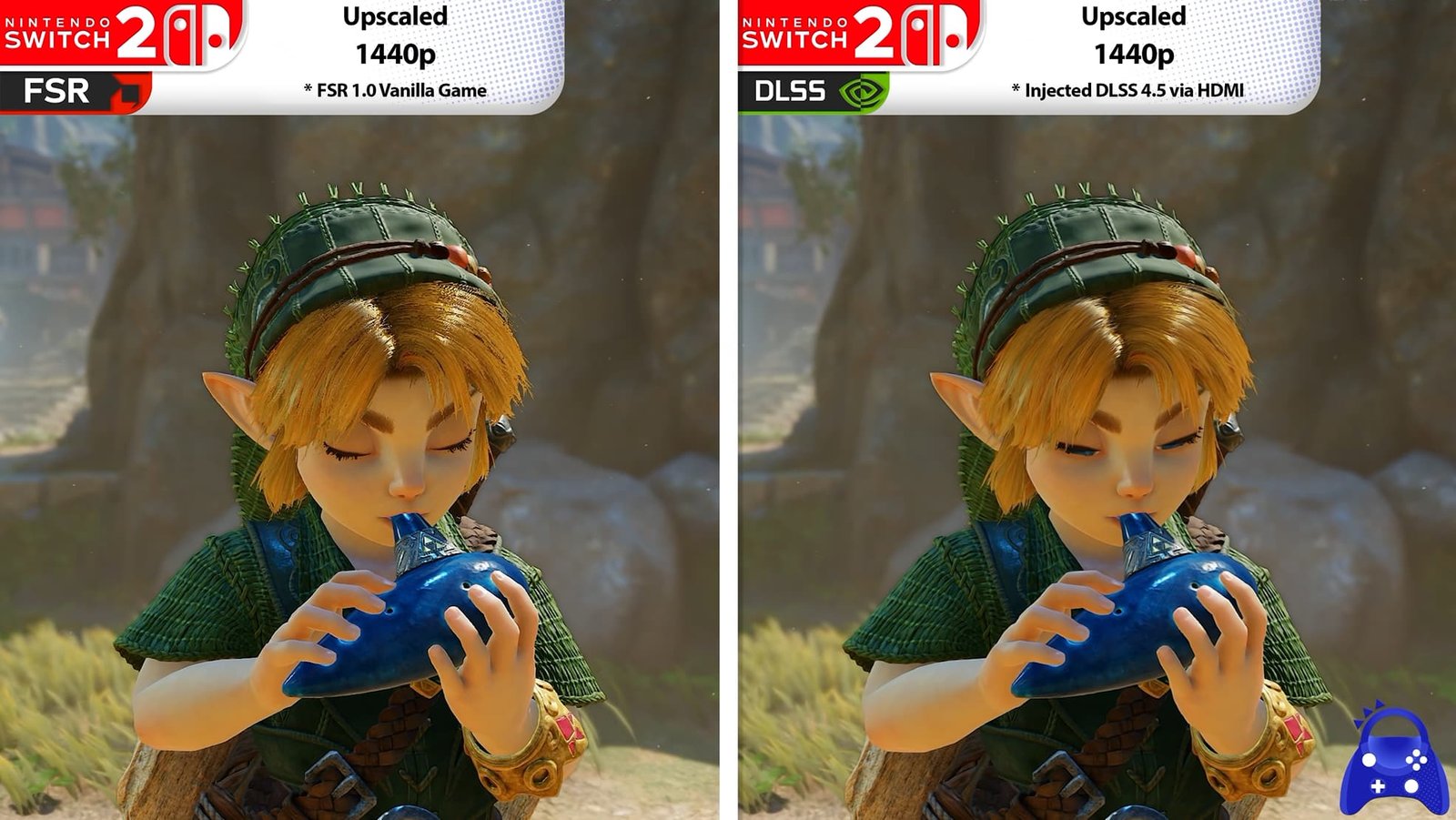
Adding a fascinating dimension to this debate, a prominent YouTube channel, ElAnalistaDeBits, undertook an innovative experiment. They effectively ‘injected’ DLSS into the Zelda Ocarina of Time Remake via an HDMI connection, processing the game’s output externally to simulate the effect of NVIDIA’s advanced technology. The results were compelling, showcasing a dramatic reduction in visual artifacts and a smoother presentation that many believe represents the game’s true graphical potential. This demonstration not only highlights the visual compromises made but also raises profound questions about Nintendo’s strategic decisions in a rapidly evolving graphical landscape for modern games.
This exploration will dissect the technical specifics of the Zelda Ocarina of Time Remake‘s visual pipeline, analyze the potential reasons behind Nintendo’s choice of older upscaling techniques, and examine the implications of the ‘HDMI injection’ experiment. By contrasting FSR 1.0 and DLSS, we aim to provide a comprehensive understanding of the technologies at play and shed light on what these decisions mean for the visual fidelity and performance expectations of future Nintendo games on the Switch 2. Ultimately, it’s a story about the intersection of legacy, innovation, and the continuous quest for the optimal gaming experience.
Unveiling the Technical Puzzle: Zelda Ocarina of Time Remake and its Graphics for Games
The Zelda Ocarina of Time Remake, despite the Nintendo Switch 2’s DLSS compatibility, surprisingly uses FSR 1.0 and SMAA, leading to noticeable visual shortcomings. An experimental HDMI injection of DLSS, conducted by ElAnalistaDeBits, vividly demonstrated the potential for vastly improved image quality, drastically reducing jagged edges and enhancing clarity in this classic among games.
Upon its release, the The Legend of Zelda: Ocarina of Time Remake quickly became a topic of intense scrutiny, particularly regarding its visual presentation. Digital Foundry, alongside the game’s official licenses, confirmed a peculiar combination of technologies at its core: SMAA (Subpixel Morphological Anti-aliasing), a technique dating back to 2011, paired with FSR 1.0 (FidelityFX Super Resolution 1.0), AMD’s initial upscaling solution from 2021. This blend of an archaic anti-aliasing method with a relatively rudimentary upscaling algorithm has resulted in a visual output characterized by prominent jagged edges and a less-than-crisp image quality.
The choice is particularly perplexing given the hardware capabilities of the Nintendo Switch 2. The console is known to possess native support for NVIDIA’s DLSS, including a more resource-efficient ‘light’ version specifically tailored for the platform. DLSS utilizes AI-driven temporal upscaling, which leverages deep learning to reconstruct higher-resolution frames from lower-resolution inputs, effectively enhancing both fidelity and performance. For Nintendo to opt for technologies that are, by modern standards, several generations behind, raises significant questions about the underlying development philosophy and technical constraints of one of its most anticipated games.
This reliance on older techniques means players are experiencing a game with visual imperfections that could, theoretically, be mitigated by the console’s inherent capabilities. The presence of aliasing across various elements of the game world not only detracts from the overall immersion but also places the remake at a disadvantage when compared to other modern titles that embrace advanced upscaling solutions. The technical decision leaves a noticeable gap between what the hardware can achieve and what the software delivers.
The HDMI Injection Experiment: A Glimpse into DLSS-Powered Games
To vividly illustrate the potential for a superior visual experience, YouTube channel ElAnalistaDeBits executed a fascinating experiment. They ‘injected’ DLSS into the Zelda Ocarina of Time Remake via an HDMI cable. While the specifics of the setup were not fully detailed by the channel, the most probable methodology involved running the game’s output through a PC equipped with an NVIDIA RTX GPU, which then applied DLSS processing to the video stream before sending it to a display. This external application of DLSS effectively upscaled the image, treating the game’s native output as a source for AI-enhanced reconstruction.
The visual impact of this ‘injection’ was immediately apparent and dramatic. The notoriously jagged edges, prevalent throughout the game when running with FSR 1.0, were significantly reduced, leading to a much smoother and more refined presentation. While the application of one upscaling technique (DLSS) on top of another (FSR 1.0) might have introduced a slight overall softness to the image, the reduction in aliasing demonstrated the transformative power of DLSS. It offered a compelling vision of how the remake could look if the technology were natively integrated.
This experiment serves as a powerful testament to the capabilities of DLSS and highlights the stark visual difference it can make. It transforms a technical curiosity into a concrete demonstration, allowing players to visualize a higher standard of graphical fidelity for the Zelda Ocarina of Time Remake and other future games. The demonstration doesn’t merely point out a shortcoming; it showcases a viable, albeit external, path to a more visually polished experience, fostering discussions about the future of graphical fidelity in Nintendo’s esteemed game library.
The Lingering Question: Why Nintendo Sidesteps Modern Upscaling Technologies in Games
Nintendo’s choice to use outdated upscaling like FSR 1.0 in games such as Zelda Ocarina of Time Remake, despite the Switch 2’s DLSS compatibility, primarily stems from two likely factors: potential performance costs and a lack of proper engine integration. This decision often reflects Nintendo’s historical emphasis on innovative game design over bleeding-edge graphical fidelity in its diverse portfolio of games.
The decision to utilize older, less advanced image technologies in a flagship title like Zelda Ocarina of Time Remake is not an isolated incident for Nintendo. Other recent titles on the Switch 2 exhibit similar trends: Fire Emblem Fortune’s Weave, for instance, reportedly lacks any anti-aliasing technology, while Donkey Kong Bananza also employs FSR 1.0. This pattern suggests a deliberate, or at least consistent, approach to graphical implementation across their exclusive games, prompting deeper inquiry into the underlying motivations.
Several theories attempt to explain Nintendo’s apparent reluctance to fully embrace modern upscaling solutions like DLSS, especially given the Switch 2’s hardware support. One primary reason could be the ‘cost’ associated with DLSS integration. While the Switch 2 does feature the necessary AI acceleration hardware (Tensor Cores) for DLSS, implementing it might still entail a higher computational overhead compared to the simpler FSR 1.0. This could translate into a greater allocation of the rendering budget, potentially leading to a loss in overall performance, such as frame rate drops, which Nintendo might prioritize avoiding in its fast-paced games.
Another significant factor is the internal development pipeline and proprietary game engines used by Nintendo. Integrating advanced image upscalers like DLSS into the rendering pipeline requires substantial development and ongoing updates to internal technologies. It’s plausible that Nintendo’s existing engine architecture may not have native, seamless support for DLSS, or that the resources required to develop such support across all its studios have simply not been prioritized. Indeed, more than a year after the Switch 2’s launch, a notable absence of DLSS in any exclusive title further supports this hypothesis.
Beyond technical and budgetary constraints, Nintendo’s long-standing corporate philosophy plays a crucial role. The company has historically been less focused on being a pioneer in cutting-edge graphical technology, choosing instead to emphasize innovative game design, unique gameplay mechanics, and compelling artistic direction. This approach has allowed Nintendo games to carve out a distinct identity in the market, appealing to players through ingenuity and fun rather than raw graphical power. This ethos could very well explain why graphical prowess takes a backseat to other development priorities.
FSR 1.0 vs. DLSS: A Comparative Look for Games
Understanding the core differences between FSR 1.0 and DLSS is crucial to grasping the implications of Nintendo’s technical choices. These two technologies, while both aiming to improve visual fidelity and performance, employ vastly different methodologies.
| Feature | FSR 1.0 (FidelityFX Super Resolution 1.0) | DLSS (Deep Learning Super Sampling) |
|---|---|---|
| Developer | AMD | NVIDIA |
| Technology | Spatial Upscaling (post-processing filter) | AI/Machine Learning (Temporal Upscaling with Motion Vectors) |
| Hardware Requirement | GPU agnostic (works on most modern GPUs, including older ones) | NVIDIA RTX GPUs (requires dedicated Tensor Cores for AI processing) |
| Image Quality | Offers a performance boost, but can sometimes introduce blurring, shimmering, or visible aliasing, especially at lower base resolutions. | Generally delivers superior anti-aliasing, sharp details, and often an image quality that rivals or surpasses native resolution, thanks to AI reconstruction and temporal stability. |
| Performance Impact | Lower computational cost, providing a more accessible performance gain across a wider range of hardware, but with potential visual compromises. | Higher computational cost for AI inference, yet often yields greater overall performance gains due to its efficiency in reconstructing high-quality frames. | Implementation Complexity | Relatively simpler to integrate into game engines as it primarily applies a post-processing filter. | More complex, requiring game engine integration of motion vectors and custom AI model training per game to achieve optimal results. |
The Impact on Player Experience and Future Games
The choice of upscaling technology has a direct and tangible impact on the player experience. For Zelda Ocarina of Time Remake, the use of FSR 1.0 means that players might encounter visual imperfections such as shimmering foliage, pixelated edges on characters, and a general lack of crispness that could detract from the otherwise immersive world of Hyrule. This visual compromise, while potentially allowing for stable performance, might disappoint players who expect a modern visual standard from a new console and a beloved franchise.
Looking ahead, this trend raises questions about the future of Nintendo’s approach to graphical fidelity in its games. Will the company eventually succumb to industry pressures and fully embrace technologies like DLSS to offer a more visually competitive product? Or will it continue its path, prioritizing gameplay innovation and unique artistic styles over raw graphical power? The tension between pushing visual boundaries and preserving a distinct artistic vision remains a defining characteristic of Nintendo’s strategy. How this dichotomy evolves will significantly shape player expectations and the visual identity of future Nintendo games and consoles, perhaps even influencing the very definition of what makes a game “next-gen.”
The Enduring Legacy of Nintendo and its Approach to Games Innovation
Nintendo consistently prioritizes groundbreaking game design and immersive experiences over bleeding-edge graphical fidelity, a philosophy powerfully reflected in the technical choices for Zelda Ocarina of Time Remake. This distinct approach has cemented Nintendo’s unique position in the gaming industry, focusing on joy and innovation rather than purely visual spectacle in its beloved games.
Nintendo’s historical trajectory clearly shows a pattern of valuing innovative gameplay and unique hardware concepts over raw computational power or bleeding-edge graphics. From the Wii’s motion controls to the Switch’s hybrid design, the company has consistently sought to redefine how players interact with games, rather than simply making them look more realistic. This philosophy is deeply embedded in its DNA, shaping development decisions from the ground up, including the technical compromises seen in titles like Zelda Ocarina of Time Remake.
This unwavering focus on experiential innovation has been a cornerstone of Nintendo’s enduring appeal. While competitors often engage in a ‘resolution war’ or a ‘frame rate race,’ Nintendo has cultivated a loyal fanbase by consistently delivering imaginative worlds, memorable characters, and engaging mechanics that transcend mere visual fidelity. For many players, the distinct charm and unparalleled fun factor of Nintendo games far outweigh any perceived graphical shortcomings, reinforcing the company’s unique position in the highly competitive gaming market.
However, the modern gaming landscape is increasingly driven by visual spectacle and technological advancements. While Nintendo’s approach has served it well, the consistent omission of advanced graphical features like DLSS could lead to a growing divergence from industry norms. This creates an interesting dichotomy: a brand that maintains its unique identity but risks alienating a segment of the audience that craves the latest visual prowess. The challenge for Nintendo lies in balancing its core philosophy with the evolving expectations of a global audience and the technical capabilities of its hardware, influencing how the next generation of its games will be perceived and enjoyed.
FAQ: Decoding the Technical Choices in Zelda Games
-
What is FSR 1.0 and why is it considered outdated for modern games?
FSR 1.0 (FidelityFX Super Resolution 1.0) is a spatial upscaling technology developed by AMD. It works by taking a lower-resolution image, applying a sharpening filter, and then upscaling it to a higher resolution. While it provides a performance boost and is compatible with a wide range of GPUs, it’s considered outdated because it operates on a single frame, lacking the temporal data (motion vectors from previous frames) that more advanced upscalers like DLSS use. This often results in more visual artifacts, such as shimmering or less stable images, compared to modern AI-driven solutions, making it less ideal for high-fidelity games today.
-
How does DLSS work differently from FSR 1.0?
DLSS (Deep Learning Super Sampling) is NVIDIA’s proprietary AI-powered temporal upscaling technology. Unlike FSR 1.0’s spatial approach, DLSS uses dedicated Tensor Cores on NVIDIA RTX GPUs to leverage deep learning algorithms. It reconstructs higher-resolution frames by analyzing multiple previous frames, motion vectors, and trained AI models, resulting in superior image quality, better anti-aliasing, and greater temporal stability. This method often delivers an image that looks better than native resolution while offering significant performance gains, providing a much more sophisticated visual experience for games.
-
Is DLSS 4.5 a real technology?
As of late 2024, DLSS 4.5 is not an officially announced or released version of NVIDIA’s Deep Learning Super Sampling technology. NVIDIA’s DLSS technology has seen several iterations, with DLSS 3.5 being the latest widely discussed version, incorporating features like Ray Reconstruction. The mention of ‘DLSS 4.5’ in the prompt likely refers to a conceptual or speculative future iteration, or a misunderstanding of current versions. The core of the discussion, however, remains valid: the potential of DLSS as a superior upscaling solution for modern games, regardless of the specific version number.
-
Why would Nintendo choose FSR 1.0 over DLSS for the Switch 2?
Nintendo’s decision to use FSR 1.0 over DLSS for the Switch 2 in titles like Zelda Ocarina of Time Remake likely stems from a combination of factors. First, FSR 1.0 has a lower computational cost, which might translate to better overall performance stability, avoiding frame rate drops. Second, Nintendo’s proprietary game engines might not have native DLSS integration, requiring significant development resources to implement. Finally, Nintendo has historically prioritized innovative gameplay and artistic design over cutting-edge graphical fidelity, a philosophy that often guides their technical choices for their vast library of games.
-
Will future Nintendo games likely adopt DLSS?
While the Nintendo Switch 2 hardware is technically capable of supporting DLSS, Nintendo’s adoption rate for such advanced technologies in its exclusive games has been historically cautious. It’s plausible that future titles, particularly those developed with newer engine iterations or by external studios, might eventually integrate DLSS. However, given Nintendo’s consistent focus on unique gameplay experiences, it’s not guaranteed that DLSS will become a standard across all their first-party releases. The company may continue to weigh performance and development costs against graphical enhancements.
-
How does the ‘HDMI injection’ experiment relate to official game support?
The ‘HDMI injection’ experiment, as demonstrated by ElAnalistaDeBits, involves processing the game’s video output externally through a PC with DLSS capabilities before it reaches the display. This is fundamentally different from official, native game support, where DLSS is integrated directly into the game engine’s rendering pipeline. While the experiment visually showcases the potential benefits of DLSS, it does not mean the game itself is running with DLSS. It’s an external post-processing effect, offering a proof-of-concept rather than a natively optimized solution for games.
-
What other Nintendo games use FSR 1.0 or similar older tech?
The reference material mentions that Donkey Kong Bananza also opts for FSR 1.0, similar to the Zelda Ocarina of Time Remake. Additionally, Fire Emblem Fortune’s Weave is cited as having no anti-aliasing technology at all. This suggests a pattern across several Nintendo exclusive games on the Switch 2, indicating a consistent approach to graphics rendering that tends to favor older or simpler solutions over the most advanced available, potentially to manage development costs or ensure stable performance.
-
Does the graphical choice affect the gameplay experience in Zelda Ocarina of Time Remake?
While the core gameplay mechanics and design of Zelda Ocarina of Time Remake remain largely unaffected by the choice of FSR 1.0, the graphical fidelity can subtly impact the overall player experience. Visual artifacts like jagged edges and a softer image can detract from immersion and the perception of a ‘modern’ remake. For many, Ocarina of Time‘s gameplay is paramount, but a visually polished presentation would undoubtedly enhance the appreciation of its world and characters. The graphical choices impact how players perceive the quality and care put into these classic games.
-
Is the Switch 2 console capable of running DLSS natively?
Yes, the Nintendo Switch 2 is equipped with hardware acceleration for AI, specifically designed to support NVIDIA’s DLSS technology. This includes Tensor Cores, which are crucial for the AI inference required by DLSS. Therefore, the console itself is capable of running DLSS natively if game developers choose to integrate it into their games. The debate isn’t about the hardware’s capability, but rather the software’s implementation and Nintendo’s strategic decisions regarding its use in their first-party titles.
-
What is the overall impact of such graphical decisions on the gaming industry?
Nintendo’s graphical decisions, while specific to its ecosystem, resonate across the gaming industry by highlighting the ongoing tension between technological advancement and creative vision. It challenges the notion that cutting-edge graphics are always paramount, emphasizing that gameplay innovation and artistic direction can still drive success. However, it also sparks discussions about hardware potential versus developer choices, pushing other console makers and developers to consider the balance between visual spectacle and optimized performance in their own games. This ongoing debate contributes to the diverse landscape of modern gaming.
The Next Step: Navigating the Future of Graphics in Nintendo’s Esteemed Games
The discussion surrounding Zelda Ocarina of Time Remake and its graphical choices encapsulates a broader conversation about technological adoption, artistic philosophy, and player expectations in the realm of modern games. The apparent reluctance by Nintendo to fully embrace advanced upscaling solutions like DLSS, despite the Switch 2’s capabilities, paints a clear picture of the company’s long-standing priorities: gameplay innovation often trumps graphical horsepower.
The HDMI injection experiment, while unofficial, serves as a powerful testament to the visual potential that lies untapped within the Switch 2’s architecture. It provides a tangible vision of how beloved classics, and indeed future titles, could look with the benefit of AI-driven fidelity. This demonstration fuels a critical dialogue about what constitutes a ‘remake’ in the modern era and how developers can best leverage available hardware to deliver both nostalgic charm and contemporary visual excellence in their games.
As the gaming landscape continues to evolve, the pressure on Nintendo to strike a balance between its unique identity and the industry’s push for graphical supremacy will only intensify. Whether through native DLSS integration, a more refined approach to FSR, or entirely new proprietary solutions, how Nintendo addresses this challenge will define the visual standards and competitive standing of its future games. The journey of Hyrule’s hero, now re-envisioned, inadvertently becomes a touchstone for this crucial technological crossroads.









Post Comment