Absolute Batman #25: Joker’s Final Plan Shocks Every Nerd
The labyrinthine mind of the Joker has always been Batman’s most formidable challenge, a chaotic mirror reflecting the Caped Crusader’s rigid order. Yet, in the unfolding saga of Absolute Batman, writer Scott Snyder and his team have redefined this legendary rivalry, pushing the boundaries of psychological warfare to unprecedented depths. The latest installment, Absolute Batman #25, plunges readers into a nightmarish scenario where the lines between ally and foe, sanity and madness, are not merely blurred but brutally shattered. This pivotal issue doesn’t just present a physical confrontation; it orchestrates a meticulously crafted trap designed to dismantle Bruce Wayne’s very psyche, leveraging his deepest fears and affections against him. It’s a narrative gamble that pays off, delivering a climax that is as emotionally resonant as it is viscerally shocking.
From the outset, the Absolute Batman series has promised a fresh, darker take on Gotham’s pantheon of heroes and villains, reimagining their core tenets with unsettling precision. The Joker, known here as Jack Grimm, is no longer merely a clown prince of crime but a calculating, empathetic tormentor who claims to understand Bruce’s trauma. This evolution of a classic antagonist sets the stage for a conflict far more insidious than any fistfight on a rooftop. Issue #25 epitomizes this new direction, forcing Batman into a corner where his physical prowess is secondary to his mental fortitude. The consequences of this confrontation ripple through the entire Bat-Family, hinting at a future for Gotham and its protectors that is both unpredictable and profoundly altered. For long-time fans and newcomers alike, this chapter represents a bold stride into uncharted narrative territory, promising a conclusion that will resonate for years to come.
Unmasking the Absolute Joker: A New Era for the Savvy Nerd
In Absolute Batman #25, the Absolute Joker, known as Jack Grimm, unleashes a meticulously crafted psychological trap against Bruce Wayne, transforming his closest allies and the very fabric of his world into a nightmarish obstacle course, challenging Batman’s resolve at its deepest level.
The concept of the Joker has undergone countless iterations over decades, each attempting to capture the essence of Gotham’s most unpredictable villain. However, Scott Snyder’s “Absolute” imprint introduces Jack Grimm not just as a new face for the Clown Prince of Crime, but as a completely re-envisioned entity. This Joker operates with a chilling empathy, claiming to understand Bruce Wayne’s trauma, a vulnerability that no other antagonist has so openly acknowledged or exploited. His motivations transcend simple anarchy, delving into a strategic dismantling of Batman’s emotional and psychological defenses, rather than just his physical ones.
Grimm’s approach fundamentally redefines the Joker’s M.O., moving away from the cackling agent of chaos to a more composed, almost philosophical antagonist. He doesn’t laugh; he observes, he analyzes, he manipulates. This calculated detachment makes him far more terrifying, as his actions are driven by a deep, albeit twisted, understanding of human psychology, particularly Batman’s. This sophisticated level of villainy appeals directly to the discerning reader who appreciates a layered narrative and character development that challenges established tropes.
This new Joker paradigm sets a precedent for how future comic book antagonists might be crafted. It moves beyond the brute force or chaotic evil, emphasizing mental and emotional warfare as the ultimate weapon. For those deeply entrenched in comic book lore, Grimm represents a fascinating evolution, proving that even characters as iconic as the Joker can be reinvented in ways that are both shocking and intellectually stimulating, offering a fresh perspective on the hero-villain dynamic.
A Twisted Reunion at Grimm Mansion
The climax of Absolute Batman #25 opens with a scene designed to shatter Bruce Wayne’s resolve: he finds his former friends and notorious villains—Waylon Jones (Absolute Killer Croc), Harvey Dent (Two-Face), Edward Nygma (Riddler), and Oswald Cobblepot (Penguin)—seated calmly within Jack Grimm’s mansion. This tableau is a direct assault on Batman’s trust and his perception of his war on crime. Earlier, Bruce had defeated the Absolute Scarecrow amidst a cornfield, a prelude to entering the mansion, where he fully expected to confront Grimm directly. Instead, he faced a more insidious betrayal.
This gathering represents the culmination of Grimm’s manipulative efforts, demonstrating his profound ability to corrupt or persuade even those who once stood against him or maintained their own twisted codes. The sight of these familiar faces, now seemingly aligned with his arch-nemesis, serves as a powerful psychological blow, undermining Batman’s belief in his mission and the allegiances he thought were immutable. It forces Bruce to question not only his enemies’ motives but also the very foundations of his war, setting a deeply unsettling tone for the confrontation ahead.
Grimm’s Calculated Sympathy: A Villain’s New Facet
Jack Grimm’s interaction with Bruce Wayne is remarkably unconventional for a Joker figure. He claims to harbor no personal grudge, asserting instead a profound empathy for the trauma that shaped Bruce into Batman. More surprisingly, Grimm confesses to fearing the “masked giant,” a moniker for Batman, suggesting a complex villain who acknowledges the hero’s power not just as an adversary, but as a force to be reckoned with. This unusual display of understanding and fear transforms Grimm from a typical supervillain into a more nuanced antagonist, one capable of leveraging emotional intelligence as a weapon.
This strategic empathy is not a sign of weakness but a calculated move to disarm Bruce mentally. By appearing rational and even vulnerable, Grimm attempts to erode Batman’s conviction, presenting himself as a sympathetic figure rather than an outright monster. It’s a subtle yet potent form of manipulation, designed to make Batman doubt his long-held convictions and the absolute necessity of his crusade. This reinterpretation adds layers to the Joker character, making him less of a cartoonish villain and more of a chilling, relatable, yet utterly dangerous psychological opponent.
The Ultimatum: Gotham’s Plea and Police Intervention
The situation intensifies dramatically as Bruce’s former allies, now seemingly under Grimm’s sway, refuse to accept Batman’s insistence on continuing his war against the charismatic aristocrat. They instead present him with a direct ultimatum: cease his campaign against Grimm, who is positioned as Gotham City’s most beloved and influential figure. Adding another layer of pressure, the Gotham City police are revealed to be en route, not to apprehend Grimm, but to take Batman to a psychiatric clinic, framing him as a delusional menace.
This scenario highlights the true genius of Grimm’s plan: turning the very fabric of Gotham society against its protector. By manipulating public perception and the city’s authority figures, Grimm isolates Batman, stripping him of his traditional support systems. The threat of institutionalization, coupled with the betrayal of those he once fought alongside or against, serves to push Bruce Wayne to his emotional and psychological breaking point. It underscores how completely Grimm has managed to subvert Batman’s world, forcing him to confront a reality where his heroism is viewed as madness.
Below Gotham’s Surface: The True Face of Jack Grimm
Escaping the mansion and the impending arrival of the Gotham police, Bruce Wayne inadvertently falls through a hidden passage, leading him into a vast cavern beneath the estate, where Jack Grimm awaits, ready to unveil his true, monstrous form.
The Descent into the Caverns
Cornered and facing an impossible choice, Bruce Wayne makes a desperate escape from the mansion. His flight leads him to a concealed passage, a chasm that plunges him into the depths beneath Grimm’s elaborate estate. This unexpected descent is symbolic, pulling Batman deeper into the villain’s true domain, a place where the pretense of civility and psychological games gives way to raw, primal confrontation. The caverns represent Grimm’s true lair, a hidden realm where his full power and horrific nature can be unleashed without restraint.
The fall itself is a moment of vulnerability, stripping Batman of his controlled environment and forcing him into an unknown, treacherous space. It’s a classic narrative device, isolating the hero before the final, most personal showdown. This subterranean setting not only provides a dramatic backdrop for the battle but also underscores the hidden, insidious layers of Grimm’s operations, suggesting that his influence extends far beyond the public eye, into the very foundations of Gotham.
A Demonic Revelation: Grimm’s Terrifying Form
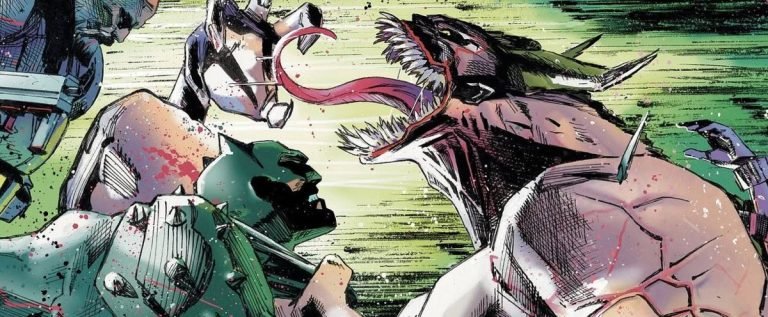
Within the depths of the cavern, Jack Grimm sheds his human guise, revealing himself as a monstrous, infernal creature, literally twice Batman’s size. This transformation is a startling visual and narrative twist, elevating Grimm beyond a mere human manipulator into a supernatural threat. Despite wielding his specialized Bat-Axe and relying on the full arsenal of his utility belt, Bruce Wayne finds himself severely outmatched against this demonic iteration of his arch-nemesis. The battle is brutal and one-sided, highlighting the sheer power gap between the hero and this evolved villain.
Grimm’s new form underscores the profound threat he poses, not just psychologically but physically. It suggests a deeper, perhaps mystical, origin to his ‘Absolute’ status, differentiating him sharply from any previous Joker. Batman, a master of combat and strategy, is pushed to his absolute limits, demonstrating that his conventional tools and training are insufficient against a foe of this magnitude. This dramatic reveal fundamentally shifts the stakes of the conflict, making it clear that Batman is fighting not just for his city, but for his very survival against a truly terrifying entity.
Barbara Gordon’s Timely Intervention
Just as Batman faces certain defeat at the hands of the monstrous, infernal Grimm, salvation arrives in the form of Bat, Barbara Gordon’s alter ego. With a well-aimed shotgun blast to Grimm’s face, Bat intervenes decisively, disrupting the villain’s assault and extracting a battered Bruce Wayne from the perilous cavern. This heroic act not only saves Batman’s life but also highlights the crucial role of his allies, even when he feels most isolated.
However, the escape is not without its ominous implications. As Bruce and Bat flee, the now winged Joker, demonstrating an even more terrifying evolution, issues a chilling promise to find them again. This defiant declaration confirms that Grimm’s defeat is temporary and his transformation has endowed him with new, formidable powers, setting the stage for future confrontations. Barbara’s intervention underscores the theme of interconnectedness within the Bat-Family, proving that even in Batman’s darkest hour, he is not truly alone, despite Grimm’s efforts to convince him otherwise.
Aftermath and Unforeseen Futures: Shifting Dynamics
In the wake of the harrowing confrontation beneath Grimm’s mansion, the immediate aftermath of Absolute Batman #25 reveals startling shifts in character dynamics and introduces unexpected developments that will profoundly shape the future of the Bat-Family.
Harley Quinn’s Unexpected Role
Following Batman’s narrow escape from the clutches of the demonic Jack Grimm, it is Absolute Harley Quinn who takes on the surprising role of Bruce Wayne’s caretaker. This development occurs at the explicit request of Alfred Pennyworth, signifying a radical redefinition of Harley’s allegiance and her place within the Bat-Family’s orbit. Her presence, tending to Batman’s wounds and psychological scars, marks a profound shift from her traditional role as the Joker’s accomplice or an anti-heroine.
During her care, Bruce offers Harley a long-overdue apology, a moment loaded with historical significance given their complex and often adversarial past. This act of contrition from Batman himself speaks volumes about the emotional weight of their shared history and the profound impact of the ‘Absolute’ continuity. It hints at a potential redemption arc for Harley and a deeper, more nuanced relationship between her and Bruce, suggesting that the psychological warfare waged by Grimm might have inadvertently forged new, unexpected alliances and understandings within Gotham’s fractured landscape.
A Bat-Family Expansion: Selina Kyle’s Revelation
The final panel of Absolute Batman #25 delivers a bombshell revelation that reconfigures Bruce Wayne’s personal life in the most dramatic way possible: Selina Kyle, the iconic Catwoman, returns with the news that Bruce is going to be a father. This unprecedented announcement introduces an entirely new dimension to Batman’s already complicated existence, instantly creating ripples across the entire DC universe, particularly within the ‘Absolute’ continuity.
This paternity revelation is a monumental shift, impacting not only Bruce and Selina’s relationship but also the future dynamic of the Bat-Family and Gotham itself. It confirms the ambitious “time jump” teased by Scott Snyder and confirmed at Fan Expo Chicago, signaling a bold leap forward in the narrative timeline. The implications are vast, suggesting a future where Batman must balance his vigilante life with the responsibilities of fatherhood, introducing a fresh, profound layer of vulnerability and motivation to the Caped Crusader. This news solidifies the issue’s status as a pivotal turning point, setting the stage for a new generation within the Batman mythos.
The Broader Implications: Absolute Batman’s Trajectory for the Dedicated Nerd
Absolute Batman #25 is far more than just a single comic book issue; it’s a strategic move within DC Comics’ broader editorial vision, reinforcing the company’s commitment to the ‘Absolute’ imprint and hinting at monumental crossovers that will reshape the known universe for every dedicated fan and comic book Nerd.
Snyder’s Vision: Redefining Iconic Villains
Scott Snyder’s Absolute Batman series has consistently aimed to redefine Gotham’s most iconic villains, stripping them of their familiar characteristics and infusing them with new, unsettling depths. Jack Grimm, the Absolute Joker, embodies this approach perfectly; he is a Joker without laughter, a figure of terrifying calm and calculated empathy, a stark departure from the gleefully chaotic villain readers have grown accustomed to. This psychological reinterpretation makes him a far more insidious threat, one that attacks Batman’s mind rather than just his body or his city.
Similarly, the re-imagining of the Scarecrow in earlier issues set a precedent for this kind of character evolution. Grimm’s strategy of turning Batman’s circle of affection into his greatest obstacle is a testament to this deeper narrative ambition. It’s a compelling choice that resonates with readers who appreciate intricate plotting and character-driven storytelling. Snyder is not just telling new stories; he’s dissecting and rebuilding the very foundations of these characters, offering fresh perspectives that challenge long-held assumptions and inject new life into the DC pantheon.
DC’s Absolute Imprint: A Bold Crossover on the Horizon
The positive fan reception to Absolute Batman #25, particularly regarding the intense confrontation and character developments, serves as a strong validation for DC Comics’ investment in the ‘Absolute’ imprint. This initiative, designed to offer bold, alternate takes on beloved characters, is clearly resonating with the audience, reinforcing the publisher’s willingness to experiment and innovate within its vast universe. The confirmation of a planned time jump, initially revealed at Fan Expo Chicago, underscores the ambitious scope of this series.
Further cementing its significance, Scott Snyder has publicly stated that the ‘Absolute’ universe is slated to converge with the main DC universe in a major crossover event around March 2027. This revelation elevates the stakes considerably, positioning Absolute Batman not as a standalone elseworld story, but as a critical precursor to a monumental event that will likely have lasting implications for the entire DC multiverse. Before this grand convergence, upcoming issues will continue to develop key characters: Bat (Barbara Gordon) will star in issue #26 in January 2027, and issue #27 will explore the intriguing alliance between the Joker and Absolute Clayface, building anticipation for the eventual crossover. This strategic layering of narrative ensures that the ‘Absolute’ imprint remains at the forefront of DC’s future plans, promising an interconnected and expansive storytelling experience.
Frequently Asked Questions About Absolute Batman #25 and Beyond
As the ‘Absolute Batman’ narrative deepens, many fans have questions about its most recent pivotal issue and what lies ahead for the Caped Crusader and his world. Here are some of the most pressing inquiries:
What makes Jack Grimm’s Joker different from previous versions?
Jack Grimm, the Absolute Joker, distinguishes himself through a calculated, empathetic menace rather than chaotic glee. Unlike traditional Jokers who revel in anarchy and laughter, Grimm operates with a chilling calm, claiming to understand Batman’s trauma and even expressing fear of the hero. His strategy is deeply psychological, aiming to dismantle Bruce Wayne’s mind and relationships by turning allies against him and manipulating public perception, rather than simply causing mayhem. This evolution presents a more cerebral and insidious villain, focused on emotional subversion over overt destruction, making him a unique and terrifying antagonist in the Batman mythos.
Who are the “friends” that betray Batman in Grimm’s mansion?
In a shocking twist within Grimm’s mansion, Batman encounters several of his traditional adversaries, who appear to be aligned with the Absolute Joker. These include Waylon Jones (Absolute Killer Croc), Harvey Dent (Two-Face), Edward Nygma (Riddler), and Oswald Cobblepot (Penguin). This gathering represents a profound psychological attack orchestrated by Grimm, as these figures, often seen as Batman’s rogues’ gallery, are depicted as calmly seated and actively persuading Bruce to end his war against Grimm, effectively turning his long-standing foes into instruments of emotional torment and betrayal.
What is the significance of Joker’s transformation into a winged creature?
The Joker’s transformation into a monstrous, winged, infernal creature twice Batman’s size is a pivotal moment, signaling a dramatic escalation of his threat level. This physical metamorphosis elevates Jack Grimm beyond a mere human villain, suggesting a supernatural or even demonic origin to his ‘Absolute’ power. It implies that Grimm is no longer confined by human limitations, possessing formidable strength and perhaps other abilities. This reveal fundamentally shifts the nature of the conflict, demanding that Batman confront a foe that is not only a psychological mastermind but also a terrifying, physically overwhelming entity, making his escape all the more desperate.
How does Barbara Gordon (Bat) play a role in this issue?
Barbara Gordon, operating as Bat in the ‘Absolute’ universe, plays a crucial role in saving Batman’s life during his brutal confrontation with the transformed Jack Grimm. Just as Bruce is on the verge of defeat, Bat intervenes with a timely shotgun blast to Grimm’s face, disrupting his assault. She then facilitates Batman’s escape from the treacherous caverns beneath the mansion. Her intervention underscores the importance of the Bat-Family’s collective strength and resourcefulness, even when Batman himself is isolated and outmatched. It highlights the continued relevance of her character and her unwavering support for Bruce.
What shocking news does Selina Kyle (Catwoman) bring to Bruce Wayne?
In the surprising final panel of Absolute Batman #25, Selina Kyle, Catwoman, returns with the life-altering news that Bruce Wayne is going to be a father. This revelation marks a monumental shift in Bruce’s personal life and has significant implications for the future of the Bat-Family. It confirms a previously hinted “time jump” in the narrative and introduces a new layer of responsibility and vulnerability for Batman, forcing him to reconcile his vigilante life with the prospect of fatherhood. This news sets the stage for entirely new character dynamics and story arcs within the ‘Absolute’ continuity.
When will the story of Absolute Batman continue after issue #25?
The main storyline of Absolute Batman, particularly concerning Bruce Wayne and the direct fallout from issue #25, is scheduled to resume in Absolute Batman #28, which is slated for release in March 2027. However, the narrative will not go completely dormant. Before issue #28, readers will be treated to further developments in the ‘Absolute’ universe. Absolute Batman #26, due in January 2027, will focus on Barbara Gordon’s character as Bat, while Absolute Batman #27 will delve into the intriguing alliance between the Absolute Joker and Absolute Clayface, providing crucial context leading up to the main story’s continuation.
Is there a planned crossover between the Absolute universe and the main DC universe?
Yes, Scott Snyder, the architect behind the ‘Absolute’ imprint, has confirmed that a major crossover event between the ‘Absolute’ universe and the main DC universe is being planned. This monumental convergence is expected to occur around 2027, coinciding with the broader narrative arc currently unfolding in Absolute Batman. This strategic move suggests that the events and character developments within the ‘Absolute’ stories are not merely isolated tales but are integral to the future direction of the entire DC multiverse, promising a significant reshaping of its established continuity and a thrilling payoff for long-term readers.
The Unfolding Legacy: Why Absolute Batman #25 Redefines Heroism
Absolute Batman #25 stands as a monumental achievement in modern comic book storytelling, transcending the boundaries of a single issue to redefine what it means to be Batman in an era saturated with superhero narratives. This issue meticulously dismantles the Caped Crusader’s world, forcing Bruce Wayne to confront not just a physically imposing foe, but a psychological assailant who weaponizes empathy and betrayal. The genius of Jack Grimm’s strategy lies in its simplicity yet devastating effectiveness: turn Batman’s trusted circle into obstacles and his city into his accuser. This narrative depth elevates the series beyond conventional action, delivering a profound exploration of vulnerability, trust, and the true cost of heroism.
The revelations within this issue—from Harley Quinn’s unexpected role as caretaker to Selina Kyle’s life-altering news of impending fatherhood—are not merely plot twists; they are seismic shifts that promise to reshape the entire Bat-Family for years to come. Scott Snyder’s commitment to a time jump and a future crossover with the main DC universe positions Absolute Batman as an indispensable cornerstone of DC’s evolving narrative tapestry. For any dedicated fan, understanding the intricacies of this issue is crucial, not just for appreciating the current story, but for grasping the foundational changes that will impact the broader multiverse. It’s a testament to the power of compelling storytelling, proving that even the most iconic heroes can still be pushed into exhilarating, unpredictable new territory. The journey ahead for Batman is fraught with new challenges, both personal and global, and it begins with the shattering events of Absolute Batman #25.













Post Comment